Liquid Comics on MagCloud

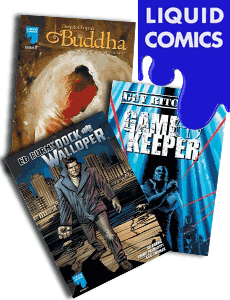
Just in time for Comic-Con, Liquid Comics are now available on MagCloud in print and iPad format.

Liquid has created graphic novels with acclaimed creators including John Woo, Shekhar Kapur, Deepak Chopra, Guy Ritchie, Dave Stewart, Jonathan Mostow, Edward Burns, Nicolas Cage, and others. Guy Ritchie’s Gamekeeper is currently being adapted for film by Warner Brothers.

And a special Comic-Con only offer – the first 1,000 copies of three special edition Liquid comics ordered from MagCloud are free!

MagCloud’s New Perfect Binding Option

One of the most requested features by publishers has been the option for perfect binding.  Perfect-bound magazines are square at the spine and use glue to hold the pages, like a paperback book. It gives your issues a more professional feel, and can accommodate a much higher page count – up to 384 pages.

Using MagCloud’s new perfect binding option is super easy:

perfectbinding1. To begin, sign in to MagCloud and go to your Publisher’s Desk.
2. Create a new magazine issue.
3. Upload your PDF or select your Flickr photo set.
4. Preview your issue. Look good? Keep going!
5. Now you get to choose a binding (saddle-stitched or perfect-bound) for your issue.
6. After you select perfect-bound you will see the “Add a spine” section, where you have a few options. You can choose to fill the spine with a solid color or upload your own design. To fill the spine with a color simply click the background color box and you will be given a chart from which you can select your spine color. If you prefer to “Design a Spine” you can download a template to create your custom design, then upload your design (JPG, PNG, or PDF format) and preview it on MagCloud. For issues over 80 pages you also have the option to create a spine with text directly from the MagCloud website.
7. Set your issue price, order a proof and you are done!  Note: because the binding process is more complex selecting the perfect-bound option does add $1.00 to your issue cost.

You can use the same PDF file or Flickr photo set for both saddle-stitched and perfect-bound magazines, but there will be some differences in the final product.  For a few tips on how to optimize your design for perfect-bound magazines or learn more about this great new feature visit our Help Section.

Enjoy this new feature and if you have any comments or questions please let us know.

Publishers Monitor Your Sales In Real Time

Hey publishers! Ever wondered where your magazines are going? Well now you can find out.

We’ve enhanced our magazine and issue sales statistics to give you a better view into how your magazine issues are selling and who’s buying them. Once you’ve published a magazine, sign-in and click the “More Stats” link at the bottom of the MagCloud home page to see your personal Sales Stats page. Here you will find up-to-date stats for your published magazines such as:

–Views on your pages (profile, magazines, and issues).
–Issue sales per day.
–Followers (anyone who’s following your work).
–Places where your issues were shipped.
–And, of course, profit!

    All these statistics can be viewed by magazine or issue and you can download the raw data for your own bookkeeping.

    We’ve had a lot of requests for this, and we listened closely. This new feature will make tracking your results much easier and hopefully more fun.

    Please let us know what you think!

    Continue reading

    Publisher Spotlight: Fotoblur Magazine

    After struggling to get his work published in print, software developer and photography enthusiast Lance Ramoth set up a little spot on the Internet where he and a few photographer friends could easily post their fine art images. Through the site, Ramoth reckoned, they could encourage one another, vote for their “community favorites” to be featured on the home page and enjoy some great talent that might otherwise go unnoticed.

    He dubbed the site fotoblur.com, and before long, with word of mouth and the magic of the Internet, itself, his small group in early 2007 blossomed into an international community of 2,500 members today and counting.

    “I was surprised by how well it worked,” Ramoth says. “The images that the community selected as their favorites were among some of the best photographs I had seen. Launching our own magazine just seemed like the next step given that we had a pool of great photographers who would provide the content.”

    And photographers who appreciate the reproduction quality of print. “It’s just dramatically better than what you see online,” Ramoth says. “Plus, Web sites come and go, but magazines can last decades. And for those of us chronically attached to our computers, it’s nice to be able to enjoy a magazine anywhere besides on our screens.”

    Ramoth’s instincts were spot on. The first issue of Fotoblur Magazine drew 600 submissions from the fotoblur.com community. Issue 2 brought in 800. By the time Issue 3 (the most recent issue) came around, Ramoth was overwhelmed with 1,400 images.

    Just as the fotoblur.com community votes for favorite images to be featured on the site’s home page, members also vote on which images should appear in the magazine. Ramoth and a small group of editors review the top 10 percent of the vote-getters, selecting 40 or so black-and-white and color images per issue that represent a diverse cross-section of subjects and a range of photographers, themselves.

    Ramoth then designs the issues, usually devoting a full page to each image with very limited text and no advertising.

    “There are already a lot of photo magazines out there with articles and ads,” he says. “But our philosophy is all about the image and the celebration of it. Each image contains a story in itself and requires a full page for it to be fully processed and appreciated by the viewer.”

    The decision to bypass advertising meant, of course, that Ramoth needed a way to print the magazine without incurring any expenses. He heard about MagCloud from a colleague and decided to give it a try.

    “I’ll admit that I was skeptical about the print quality,” he says. “But when I held the first issue in my hand, I was simply blown away — it truly exceeded my expectations. The color of the images was spot on. There was little to no color cast on the black-and-white images, which was one of my major concerns. I just remember thinking, I really did it!”

    Since Ramoth runs fotoblur.com and manages the magazine almost singlehandedly, he appreciates that MagCloud handles all the printing, shipping and order processing details. He looked into working with a few newsstand magazine distributors, but found that the upfront costs and the need for advertising to support the distribution would have threatened his creative vision. “MagCloud allows me the freedom to concentrate on the results I desire creatively,” he says.

    As each issue is published, Ramoth spreads the word via fotoblur.com, as well as through Twitter (@fotoblur) and digital publication sharing services like Issuu (issuu.com) and Scribd (scribd.com) and various file sharing services. Contributors to the issues also help publicize the magazine’s availability.

    Ramoth makes the issues free to download and view online and supplies links to MagCloud for those who’d like to purchase the print version, $15.40.

    Ramoth hasn’t given up on his hope to turn Fotoblur into a newsstand magazine if he can attract enough purchasers. He’s also considering combining all four of this year’s issues into a hardcover book.

    His advice for other potential magazine publishers? Purchase a good software package, create the content and do it. “When I told people that I wanted to start a photography magazine, they thought I was crazy,” Ramoth says. “But I just didn’t listen — I just did it anyway.

    “Be creative, publish, then promote,” he adds. “It’s an amazing experience in itself, and you’ll feel something special when you turn that idea in to something tangible.”

    Check out the latest issue!

    Get The Inside Scoop on the Oscars

    The Motion Picture & Television Fund’s 8th Annual “Night Before” Party, held on Oscar eve at the Beverly Hills Hotel, is one of the hottest pre-Academy Awards tickets, and this year’s gift bags will include a limited edition Daily Variety, commemorating Oscar 2010, printed exclusively through MagCloud.

    Daily Variety’s ‘Oscar 2010’ will get you ready for Oscar night with awards season analysis, photos of the nominees for all the major award categories and trivia from Oscar’s history. While the magazine was developed especially for the Night Before’s celebrity guests, HP and Variety have made a limited quantity available for purchase via MagCloud.com. Proceeds from the magazine will go to The Motion Picture & Television Fund (MPTF).

    MPTF is a charitable organization that offers assistance and care to those in the motion picture and television industries with limited or no resources. Its mission is to enrich the lives of people in the Southern California entertainment community by continuously evolving to meet their health and human services needs.

    Daily Variety’s ‘Oscar 2010’ is a must-have, whether you have a golden ticket to the event on March 7, or are watching from the comfort of your home. All profits from your purchase of Daily Variety’s ‘Oscar 2010’ will be donated directly to the Motion Picture & Television Fund. This is a limited edition (only 2000 in print) so order your copy today!

    Publisher Spotlight: Wally Dog’s Tale

    As an educational assistant at the Edmonton Public School District in Alberta, Canada, Irene Read has plenty of experience in educating children with special needs — children with autism, in particular. She noted early on in her teaching career that these youngsters struggle to focus — and the importance of simplicity in communication.

    To help increase the children’s comfort and comprehension levels, Read began taking photos of various objects and using them as part of how she communicated. “If we were going to the washroom, for example, I’d show a picture of the washroom,” she says. “For some, these photos did help them make the connection much more quickly.”

    With photographs making such a difference in her classroom, Read began thinking about applying the same concept to children’s books.

    “Books with fantasy illustrations are gorgeous, but children with autism have enough trouble relating to the real world, let alone sorting out graphic interpretations of reality,” Read notes. “And they can’t process visually complicated, busy pages. I thought that seeing real photographs on the pages would make more sense to them — just as we’d seen in the classroom. And I also thought that not just autistic children, but all children could really appreciate the merit of one photograph presented on a single page.”

    An avid photographer with a willing model in Wally Dog, her family’s 10-year-old Jack Russell Terrier, Read put together a simple story using large photographs of Wally and short captions to describe him. She wasn’t sure what to do with it until her husband mentioned reading about MagCloud in their local Edmonton Journal newspaper.

    The idea that she could produce a magazine about Wally with no upfront costs seemed like a perfect fit. She uploaded her first 12-page issue of Wally Dog’s Tale to MagCloud’s Web site and, when it was ready for printing, began telling her friends and family members.

    “I got a lot of positive feedback and a lot of smiles,” she says. “Everyone who knows Wally loves the magazine. My mother-in-law sold a few copies at her senior center. And a couple of friends bought copies. One friend purchased a copy because he says he thinks I’m going to be famous!”

    Read followed the first edition with a 16-page issue, this time introducing Wally’s friend Bird — the family’s pet dove. The issue features photos of Wally and Bird with simple captions describing them playing, eating and taking naps together.

    The next four issues are based on a true story of a missing Bird and all the places Wally searches for him. The tale ends well — Wally finds Bird trapped under a basket and rescues him.

    Working with MagCloud, Read says, couldn’t be easier. The responsive staff is always on hand to answer any questions. And since the magazines are primarily for children, she’s especially pleased with the thick, durable paper stock.

    Read promotes Wally Dog’s Tale through word of mouth and hopes to attract the autism community and pet lovers everywhere. When she returns to school next year — she’s on leave at the moment — she’ll be eager to see firsthand how her students respond to Wally Dog.

    “I hope that adults who love to read to children and talk about what they see in the pictures will enjoy the magazines,” Read says. “And I hope that children with autism find them attractive and informative as they try to make sense of the world. It’s thrilling to see something that was initially just a little hobby come together in material form.

    “MagCloud lets anyone turn ideas into reality,” Read adds. “Unlike big magazine publishers that must please the tastes and interests of the ‘majority’ to increase sales, MagCloud gives everyone the opportunity to publish regardless of interest area or niche.”

    Check out the latest issue!

    The SUNDANCE FILM FESTIVAL – Then, and Now

    As a kick-start to SUNDANCETWENTYTEN–the 26th Sundance Film Festival hosted annually in Park City, UT–the Sundance Institute has released an exclusive look at their 26-year legacy of innovation and impact on film. The magazine features the entire collection of festival posters, prominent films, and lists of winners from each year. You can also read about the evolution of the festival and how the Sundance Institute is leading the charge to discover, champion and spread brave new ideas.

    RETROSPECTIVE is available exclusively on MagCloud, and proceeds support Sundance Institute, a not-for-profit organization dedicated to the discovery and development of independent artists in film and theatre.

    Get Your Copy Today!

    Publisher Spotlight: Medical Science Liaison Quarterly

    In the pharmaceutical and healthcare industries, ethical practices directly affect patients’ lives. One incorrect use of a drug to treat a disease for which it’s not approved could result in a significant adverse reaction — even death. To help ensure their products are used properly within the healthcare community, companies often employ medical science liaisons (MSLs) to build and foster collaborations with hospital and university scientists, researchers and physicians — and even government constituents.

    No one, perhaps, is a better expert in, and advocate of, the contributions of MSLs than Jane Chin Ph.D. A former MSL herself, Chin created the Medical Science Liaison Quarterly (mslquarterly.com) in 2003, the first Web site — in fact, the first resource — devoted specifically to MSLs.

    “Even though MSLs connect with so many people, it can be an isolating job,” Chin says. “Most work from their home offices. When I was an MSL, there was nothing on the Internet or in print that pertained to our field. So I started my own Web site.”

    Chin researched and wrote articles and reports that she knew would interest MSLs, and she even conducted surveys and shared best practices. Her site became so popular that she left her job and founded the MSL Institute (mslinstitute.com) the very next year.

    Along with offering MSL hiring, training and consulting services, Chin continued to publish the MSL Quarterly online. Eventually, she noticed bits and pieces of her valuable work appearing in other consultants’ training binders and presentations. She needed a publishing medium that would offer more copyright protection than the Web — one that would be immune to simple copy and paste computer keyboard commands.

    “A friend told me about MagCloud, and while I know that a print magazine won’t eliminate plagiarism, it certainly makes it more difficult,” Chin says. “Plus, I liked the idea of offering clients something tangible. MSL Quarterly isn’t for leisure reading. It’s something you really want to concentrate on. Having it in print means readers can underline helpful passages and make notes in the margins.

    “For mass distribution, yes, digital is a good way to go,” Chin adds. “But for a focused audience like mine, I was very excited to move to print. There’s nothing like holding paper in your hand.”

    Chin published her first print issue of MSL Quarterly in January 2009 ($47), a 28-page issue focused on MSL training and business acumen. She quickly followed with nine more issues covering everything from compliance and clinical trials to metrics and salary surveys.

    While most issues contain new content, Chin likes that she can revise and print popular articles and reports from the more than 100 in her MSL Quarterly Web site archives. She’s even published popular chapters from in-depth research reports as their own individual magazines.

    Chin promotes each issue through both her MSL Quarterly and her MSL Institute sites. She includes links to MagCloud’s site, inviting readers to preview the issues before placing orders.

    Because MSL Quarterly is a scholarly publication, Chin appreciates MagCloud’s easy-to-use layout template and the print quality. “My readers are just interested in content — not the design — so a simple template works fine for my purposes,” she says. “The print quality is what’s important. My magazine is semi-glossy with full color. I’m very pleased by the quality and consistency of each issue.”

    And, of course, the price is right. “I really need to keep my overhead as small as possible, so I love that MagCloud has no upfront fees,” Chin says. “I’m willing for MagCloud to take a percentage of each magazine I sell. I feel much better about that than having my profit eliminated all together by people illegally sharing my work.”

    So has the magazine eliminated all MSL Quarterly copyright violations?

    “Obviously, if someone wants to plagiarize or otherwise violate copyrights, there’s little I can do to prevent it,” Chin says. “However, a company training department recently placed an order for a large quantity of magazines to distribute to its MSL team. Before, they’d probably purchase one of my articles online and then email it to everyone. So, overall, I’d say that printing the magazine has reduced copyright infringement and the illegal sharing — both of which were cutting into my bottom line before.”

    Check out the latest issue!

    How to Publish a Magazine in a Day and a Half

    When the biggest dust storm in 70 years blew through Australia, the photos of it were stunning. So on Wednesday at noon, I decided to make a photo magazine. It was published on MagCloud Thursday night. All told, it was 31.5 hours from idea to publication, and that’s with a few hours of sleep thrown in. I think this shows the power of print-on-demand in general, and MagCloud in particular, so I wanted to share my experience and show you how you can do it, too.

    Editor’s Note: This post is courtesy of Derek Powazek.

    Step 1: Pick a Topic

    In this case, the dust storms were news, so I started with that. You can go with something timely, something you happen to know a lot about, or something your friends are smart about. Go with what you know.

    Step 2: Gather Content

    This is the most time-consuming step. For my magazine, I started by writing to a few friends I had in Sydney. Then I searched Flickr for photos I liked, and wrote to the photographers to ask for their participation (here’s Flickr’s FAQ on this). I also found a group on the topic and posted there.

    Important: Flickr photographers, especially good ones, are inundated with requests for their images. If you contact someone, take the time to write a good message. Introduce yourself, say what exactly you’;re asking for, and why you’re asking them. Remember that you’re asking them to trust you, and you’ve gotta earn that trust

    In my message, I made sure to say that I was going to publish the issue on MagCloud, but that I would set the markup to zero so I wouldn’t be making any money on the work. I also offered to send them a copy of the printed magazine if their work was selected

    I asked for their name, a short bio, and their URL. (If you can’t pay people, the least you can do is make sure they’re credited appropriately and promote them on a contributor page with a bio and URL.) I asked for a mailing address for the printed copy and the high res version of the photos. Finally, I asked them to email all of that to my Gmail address

    Remember to also say that you’re not asking them to give up their copyright; just grant you permission to use the photo in this specific case. Photographers are increasingly savvy about this, as they should be.

    Another option would have been to seek out Creative Commons licensed photos; you can even search Flickr for them; but I wanted to make direct contact with the photographers. I sent 74 invitations.

    Step 3: Wait for Permission

    I can’t tell you how important this is. Do not just grab photos from the web and use them. The photos will look terrible, you’ll violate MagCloud’s guidelines, and you’ll piss off a lot of photographers. And, oh yeah, it’s illegal.

    In my case, within a few hours, I had received 124 submissions from 55 people. Only one person politely declined. No one was angry or offended that I had asked.

    Step 4: Design the Magazine

    Now that you’ve got all the content, it’s time to design the magazine.

    Here’s where you might have to hire a talented friend. For me, print design is my happy place; I’ve been doing it since high school ; so I cranked up InDesign and got to work. If you’re just starting out, MagCloud has templates.

    I decided to do a 40 page magazine to keep the price as low as possible while still creating something that was heavy enough to feel substantial. That gave me a series of spreads to play with.

    Aside: I love the challenge of placing photos together. Whenever you pair images, the reader will create a mental story about why those images are together. Some spreads are about content (people, water, buildings), while others are about color or shape. I could geek out on this for days. And I have.

    I was able to include 54 photos by 34 people in the final design.

    Step 5: Break the News and Proof

    Now that the design is done, you know who’s in and who’s not. Now you have to break the news to your contributors.

    I made two labels in Gmail accepted and rejected and sorted all the submissions into one or the other. Then I replied to each submission with one of two emails. For the ones that didn’t make it, I thanked them profusely for trusting me with their work, reassured them that it was great stuff, and apologized for not being able to find space for it. Be truthful here – people will understand. For the ones that were accepted, thank them profusely, and ask for their help one more time.

    I made a screen-resolution PDF of the magazine and sent it to each of the accepted photographers. I asked them to help me proof it, making sure their name, bio, URL, and photos were all right. No matter how hard you proof something, there are always mistakes, and if everyone takes a moment to look it over, you’ll catch them all.

    I also strongly believe that when people are contributing their work for free, you owe it to them to make sure you get it right. They should be as excited about it as you are. Giving them a PDF preview helps you share in the joy of making a magazine together

    The email also gives everyone one last chance to bail before its too late. If someone absolutely hated it for whatever reason, you could still easily remove it. Once it’s online and people have seen it, it’;s more difficult to make corrections.

    In my case, several contributors wrote back asking for corrections, which were easy to make. But most just wrote back to say it looked great.

    Step 6: Publish!

    This is the easiest step, thanks to MagCloud. In the bad old days, publishing would mean days of printing, waiting, deliveries, and endless packing and mailing. Now all you have to do is kick out a PDF and upload it to MagCloud they take care of the rest.

    I hit the Publish Now button at 7:30pm on Thursday 31.5 hours after I had the idea. You can see it here.

    Step 7: Followthrough

    Once the issue is up, you’ve gotta tell people about it. MagCloud has some promotional tools in place, but there’s no substitute for your own connections. I emailed a few friends, posted to Twitter and Facebook, and of course posted it to my site.

    I still have a little work to do. I’m going to make sure that copies get into the mail to the contributors, as promised.

    But, really, I can’t believe how easy it was. Making print media used to be so difficult. I remember cutting and gluing long columns of text together, shooting flats, and generally sweating for days to create my college newspaper. Now the the most time-consuming part is simply asking for permission from the content creators.

    I share this story not to brag about how clever I am, and my mom assures me that I am, but to show how everyone can make real, live printed magazines, too. The content is out there, the people are willing, and the tools have never been easier.

    What’s your magazine going to be?

    Editor’s Note: Strange Light Magazine has been receiving international acclaim. See RexBlog and TIME Magazine for recent coverage.

    Publisher Spotlight: film & festivals

    From Prague to Paducah, large cities and small towns around the world play host to 4,000 film festivals annually, attracting millions of filmmakers and cinema lovers eager to see their favorite artists unveil their silver screen masterpieces. While Variety and other mass media outlets cover the likes of Cannes and Sundance, only film and festivals magazine covers them all, even the smallest of festivals, spotlighting independent filmmakers who wouldn’t normally attract attention from the mainstream press.

    “We were getting a good reputation for the quality of our coverage, so we decided to carry on,” Patmore says. “We opted for a digital format magazine, which happened to coincide with our already planned ‘green issue,’ in which we covered the environmental impact of film festivals and the movie industry. So we thought that would be a good tie-in as we relaunched the magazine in digital format.”

    Recognizing the value of print, however, Patmore was hesitant to give it up entirely. When he searched the Web for print-on-demand resources, he found MagCloud.

    “I thought it would be a good complementary option to the digital version because we could print with MagCloud without any upfront costs or any minimum orders,” Patmore says. “So we decided to give it a try, and here we are.”

    Each issue of film and festivals features a specific theme, including that first environmental issue. Other topics so far have included filmmaking in Australia, Latin America and in Asia, children’s film festivals, microbudget British films and a spotlight on women filmmakers around the world. Thanks to the affordability of MagCloud, Patmore now publishes 10 issues a year instead of the original four.

    A small team of writers and regular freelancers, along with guest contributors — usually indie filmmakers, themselves — provide the magazine’s content. Patmore solicits story ideas from them and makes assignments, tapping into each writer’s area of expertise. After editing the incoming pieces, he spends about five days designing the magazine and sourcing the photography. He then uploads the files to MagCloud for the print-on-demand version of the magazine, as well as to Yudu (yudu.com) for the digital version.

    “I’m very impressed with MagCloud’s quality,” Patmore says. “I used digital printing for other jobs years ago. The technology has certainly improved. And you can’t beat having a magazine you can hold in your hands. I still feel the best way to read anything is on paper. I also like the archival advantages of print. However, I suspect that at the moment most of our magazine sales are to people who appear in the magazine and want to show it to others.”

    And print publications, Patmore has learned, have higher credibility among publicists than Web sites. “It seems that the public relations companies still have far more respect for print — print journalists are always accorded more talent access despite the fact that we now have far more online readers,” he notes. “In those terms, it is important for us to remain in some sort of print format just to ensure we can get the best content for the articles.”

    Patmore promotes the magazine by word of mouth, the film and festivals Web site (filmandfestivals.com) and through Facebook. And these days at festivals, instead of handing out free issues, Patmore and his team distribute promotional postcards detailing how to order copies.

    The result? “The sales of our print magazine have been very slow to start with, but are increasing,” Patmore says. “And we’ve had nothing but positive feedback for both the quality of the content and the design. Since most of the feedback is coming from film professionals, it’s very heartening.

    “The print magazine was never intended to be a major source of income for us, but to serve as an alternative to the digital version,” Patmore adds. “It has certainly turned out to be more profitable than our previous print version, which only lost money. Most of our readers access our free digital version, but we see a growing number of people buying the print-on-demand version.”

    Patmore’s advice to aspiring magazine creators: “If you want to do it, then do it — it can be done now almost without any capital outlay,” he says. “But make sure the content is worthy of your intended readers. Quality should be the driving force — well written, grammatically correct articles; good photography and good design with legible, correctly formatted typography. If the design aspect is not good, then it might as well be a Web site or blog.”