The Importance of Layouts and Templates

Whether you’re a design newbie, or a seasoned veteran, sitting down to create a new publication can be a daunting task. There’s nothing more frustrating than staring at a blank page, feeling stuck, and unsure of where to begin. It’s often easier to change things that don’t work for you, than to completely start from scratch, which is why we suggest starting with an existing document. It can be the design of a similar publication, or a simple template that has preloaded margins, column guides and style sheets, that you can quickly adjust for a head start. The advantage of dong this, it that the basics of the page are already in place so you can focus on your content and styling.

Why use a template?

Whether you are creating a 12-page or 120-page publication, if you plan to create a series with the same style, you’ll definitely want to invest the time to develop style sheets, and come up with a few layouts that you can repurpose each time you publish. This will help you keep a visual consistency not only throughout each publication, but also from publication to publication over time.

Some of our publishers have done a great job of this, and you can see how it helps reinforce their brand to have consistent styling throughout each publication.  Check out a few issues of Hacker Monthly or Livestrong, or portfolios by professional photographer David Livingston and you will see what we mean. Each of these publishers have developed a consistent style using templates that is unmistakably and identifiably their own.
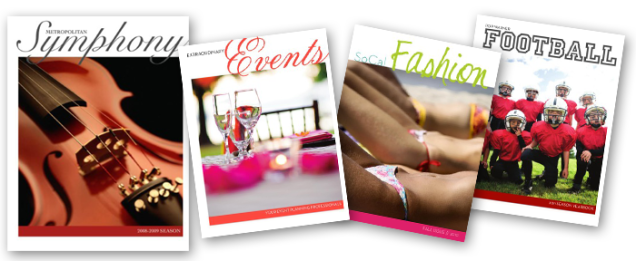
Not an expert at design? No problem. Using a professional-looking template can increase your credibility, and make any publisher look like a pro. Find a template that has a style that resonates with you and use it as a springboard to get yourself started. You can see some great examples of this in our blog post Easy Design with Templates in Apple’s [iWork] Pages, where we turned a basic Symphony Program into a business services guide for an event planning company, a sports team yearbook, and a fashion magazine, with just a few changes in font, colors and photography.

Finding Templates
Where to look and what to look for…

Some software comes equipped with built-in templates, and you can also find great free and paid templates online at the companies’ websites, like Microsoft has for Word and Publisher here, or Adobe has for InDesign at Adobe.com

Still can’t find what you need? Other resources exist where you can buy specific designs for your needs and many of these sites make their templates available for a variety of design programs like Inkd and Stocklayouts.com.

When picking your templates, there are a number of things to consider for your publication:

1. Is this template for an 8.5″ x 11″ document? If it’s designed as a 17″ x 11″ spread, do I know how to adjust it to the right size?

2. What sort of page-layouts are included in the template?

3. Does the template have the right ratio of graphics to text for my needs?

4. Are there hidden layouts that I don’t see? * Hint: if you are using iWorks Pages, there probably are!

5. Does the style suit the audience I am trying to reach? If not, is it easily changed with a few font/color tweaks?

6. Don’t feel restricted by the stock photography or color palette used in a template. Keep in mind our example of the Symphony Program being transformed into a fashion magazine or an event planner’s business collateral

7. Ask yourself, “This template isn’t designed for my specific use-case, but does the overall layout and feel fit my purpose? Could I transform it into something that works?”

Ready to customize your template?
A few tips for making any template fit your needs.

– Unless you get a template directly from our blog, you will likely have to alter some of their settings to accommodate MagCloud’s printing requirements. Before you start making any edits to your template, be sure the document settings match those in the MagCloud Help Section.

– When you make changes to fonts and colors, always do this by editing the font or paragraph style sheets. This way, if you don’t like a change that you have made, it will be easy to adjust and will change that style use on all of the pages of the template.

– Always start with the original file and make 2 or 3 versions, each with different fonts or colors. Then save each as it’s own template so that you can compare them and easily decide which one you like best.

Ready, Set, Start Publishing!

Now that you have your template selected, it’s up to you to make it your own. Need a bit of extra help? Check out our other Tips & Tricks blog posts, or visit the help sections of your software’s site. Many of them have great how-to resources and videos to help you on your way.


Adobe InDesign

Microsoft Office

iWorks Pages

Put MagCloud to Work

You heard that right. MagCloud can help bring your professional projects to life in print and digital. Our service is a great way to showcase your work to customers, clients, colleagues, partners etc.

Besides magazines, we’ve seen a variety of creative ways that MagCloud customers have used our service for their most demanding business needs.  So whether you are creating a portfolio for client meetings, company brochure, customer newsletter or product catalog, MagCloud will take your publication from PDF to printed magazine and digital download with just a few clicks of the mouse. Planning an event? We’ve got you covered there too. Our event planners and marketing customers have utilized MagCloud to print event souvenir programs, meeting programs, handouts and brochures. You can even publish your workshop manuals with us too.

Whatever the purpose – fun, commemorative, professional or informational – there are no boundaries to the way people are using MagCloud. Let us bring your story to life. MagCloud can help promote your company, products and services in both professional quality print format or digitally for viewing on a PC or mobile device. Whether you are ordering 1 or 1000 copies, MagCloud will ship your business documents to customers and colleagues all over the world. Visit magcloud.com/work and learn about the many ways we can help you make your next gallery exhibit, client meeting, workshop, convention and fundraising event that much better.

What other ways do you use MagCloud? Share your past, current projects and future ideas in the comment section below.

Create a Calendar with iWork’s Pages

Today we are focusing is on creating a calendar with Apple iWork’s Pages.

Hey PC users: check out yesterday’s post about using Microsoft Word, or check back tomorrow to see  how to use MagCloud’s Flickr Uploadr to create a super cool calendar with just a few clicks of the mouse.

Let’s get started with Pages.

I’m a new fan of Pages, (Apple’s design tool that comes in their iWork productivity suite) and if you are Mac user looking to do some basic design without spending a ton (iWork retails for just $79 at store.apple.com) it’s an easy program to use, and is great for projects like a family calendar.

You can create a lot of great looking calendars using the exact same template, just by making a few changes to fonts, color and pictures.

Preview Wedding Photography Calendar Preview Parma Photography Calendar on MagCloud Preview my Family Calendar on MagCloud

GETTING STARTED:

The template is already set up with 28 pages, so making a few customizations and saving the file as a PDF should be quick and easy!

Download the basic calendar template that I designed here, or at the bottom of this post, you can preview and download some of the variations that I created using the same template, by making a few modifications to the style sheet.

MAKE IT YOUR OWN:
Because I designed this template for use with MagCloud, it’s already formatted to accomodate bleed and trim settings. This means you can just start modifying the style to fit your needs. Because this Pages template has a built-in Paragraph style sheet, it will be easy to keep a consistent style throughout your calendar.

Change view to “Facing pages”
This not only helps with visualizing layout, but also will help you keep the orientation of your photos straight when placing them in the document.

Styling your Calendar
Not making a family calendar? Then go through each page and make the necessary adjustments to layout and fonts. As I mentioned before, all of the above calendars use the exact same layout, with slight tweaks to the fonts and colors. It’s amazing how simple style changes can make a template your own. There are 3 styles in the template: “Title,” “Days of the Week” and “Numbers of the Month;” so changing these styles will transform the look of your calendar. Let’s get started!

Adjusting a Paragraph Style:

Show Font Window1. Expose the “Font Window” by selecting the “A” icon in the Toolbar (If for some reason you don’t see the toolbar at the top of your application frame, then Select VIEW >> Show Toolbar, then select the “A” icon)
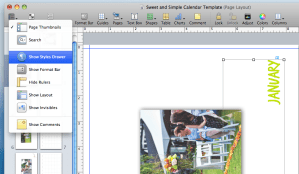
Show Styles Drawer

2. Select a block of text that you wish to modify

3. Make desired changes to font, size, weight and color using the “Font Window.” As you make selections, you should see the font change on the page.

4. Expose the “Styles Drawer”

Redefine Style from Selection

5. Select the block of text again–notice how it highlights the selected style in the “Styles Drawer.”

5. Update your paragraph style sheet so that all of the subsequent uses of this style reflect the style changes. You can do this by either “right-clicking” or “ctrl+ click” on the name of the font style in your “Styles Drawer”, then select “Redefine Style from Selection.”

Adding Special Dates to the Calendar:

Half the fun of making your own calendar, is including special dates that are important to you. So, whether you are creating a calendar for your child’s sports team, and you want to include their match dates; or if you are creating a calendar for your family, and you want to include Birthdays and Anniversaries; or if you want to create a calendar for your business and include special events and sales– it’s easy to do.

Because the numbers of the month are dependent on one another, typing directly in the square won’t work. Instead, follow the instructions below to add text boxes to your calendar. (Tip: You can also use these steps to add captions to your photos)

1. Select the Text Box Icon from the Toolbar (it looks like a “T” in a box)–
this will create a small box that you can move around the page

2. Type the information (ie. “Mom’s Birthday” or”Ladybugs vs. ‘Lil Giants”)

Grabbing the corners of the frame, adjust the size to 1.4 x1.03. Grabbing the corner of the text box, adjust the size of the box to 1.4 x 1.0 (this way you can see how it will fit in the day’s square)

4. Adjust the size if the text so that it fits well inside the box and select your desired color and font.

Create New Paragraph Style

5. Highlight the text again.

6. In the Styles Drawer, hold down the “+” at the bottom of the menu and select “Create New Paragraph Style from Selection” (You can also select FORMAT >> “Create New Paragraph Style from Selection” from the application menu bar)

7. Name your new style. This makes it possible fro you to use this style for other dates as you add them to your calendar.

Rotate the Text Box using the Metrics Tab in the Inspector toolkit8. With the text box selected, go to the “Metrics” tab in the Inspector window; use the rotation settings to rotate the text 90º.

9. Drag the box to the appropriate date on the calendar page.

Tip: Save yourself some extra steps by copying and pasting this text box throughout the document. (Select the text box and use “command+ C ” and “command+ V” to copy/paste) Then you can change the text, but it will maintain the style, size and rotation.

Save your file as a “Template” for future uses

If you plan to create another calendar, be sure to save your personalized document as a template. It’s easy to do, just select “File> Save as Template.” This puts a copy of your file into the Pages Template Chooser so you can find it easily next time you launch the application.

Tip: Because your using a template to create your calendar, and have the power of HP MagCloud’s digital printing, there’s no reason you can’t personalize your calendars… Perhaps change the cover image for Aunt Margaret’s calendar? Or make one with more photos of the kids for you In-Laws? Or create calendars that cater to your clients or program sponsors… it’s up to you!

TURNING YOUR DOCUMENT INTO A PDF:
You’re done designing? Yay!
This part couldn’t be easier! Simply select “FILE>> Export.”
Leave the default settings for PDF, and save your file.

WANT MORE INFORMATION ABOUT PAGES?

Apple’s Pages ’09 site

Apple Store: iWork $79

PREVIEW the modified templates:

Preview Wedding Photography CalendarPREVIEW Template modified for a wedding photographer on MagCloud


PREVIEW Template modified for the PopWarner Team on MagCloud


PREVIEW Template modified for a business (Venetian Glass Blowers) on MagCloud


Preview Parma Photography Calendar on MagCloudPREVIEW Template modified for Parma, Italy Calendar on MagCloud


Preview my Family Calendar on MagCloudPREVIEW Template modified for a family calendar on MagCloud


Transform Templates into Professional Publications

Who says you have to be a professional designer to create a MagCloud-ready PDF? The MagCloud team has been exploring a variety of word processing and basic design applications that make creating a magazine super simple.

First up was Microsoft Word.  There are a large number of Word templates available that are almost perfectly designed for creating MagCloud magazines.

Whether you are visiting Microsoft’s Website, or the program’s built-in project gallery (available on a Mac), you can find great templates to get you started on creating your brochure, catalog, calendar or just about any other document you can imagine.

I’ll be using the “Brochure” template here as a pilot, but we’ll explore other templates in the future.

The original Microsoft version is available Download original Microsoft Template and my MagCloud-ready version is available Download MagCloud Ready Template.

GETTING STARTED:
To get started, you’ll want to start by finding and opening your template.

In this case I found mine in the “Project Gallery” within the Microsoft Word application. Because the template is designed for a US Letter sized paper (8.5” x 11”) it will be really simple to modify for my own use.

ADJUSTING MARGINS:
Because MagCloud trims its documents to 8.25” x 10.75” we are going to lose 0.125” inches off the top and bottom, and 0.25” off the outside edge. This means in order for our template to be centered on the printed page, we are going to have to adjust the margins. Doing this consistently on every page can be tough, so I use a little trick with the document margin settings and offset them by 0.25.” This way, when the pages are trimmed that 0.25” off the outside edges, the content of the page still looks centered.

To access these settings, you will go to Format>>Document. Using the settings in the screen shot below, you can adjust the margins on the page, and then proceed to adjust the content so it fits within the guides. *Be sure to select “Mirror margins” to see the inside and outside margin options. In this example the document had a 0.5” margin all the way around, so I adjusted the margin by -0.25” on the inside, and +0.25” on the outside.

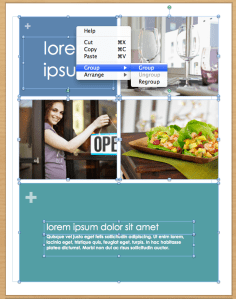
Adjusting the individual elements on each page can be tricky, so I recommend selecting one item on the page, using “ctrl + A”(PC) or “cmnd + A” (Mac) to select all, then right-clicking (or in some cases ctrl+click) on the mouse and selecting the option “Grouping>Group” to group the objects together. This allows you to move all of the page’s contents at once, so you don’t lose the integrity of your design. Be sure to reverse the process by right-clicking after the move and select “Grouping>Ungroup”, so you can once again modify the elements individually.

MAKING IT YOUR OWN:
Microsoft does some pretty awesome things with their Word templates by establishing color and font palettes, for the more novice user, this means you can keep your fonts and colors consistent through the document, and for those feeling a bit more daring, you can actually customize the palettes to make the document more your own. Each template comes in a set of colors, and fonts, but you can mix and match these to suit your needs.

Below you will see the same template with a different color schema and font collection.

TURNING YOUR WORD DOCUMENT INTO A PDF:

Microsoft Word 2003: To export your Word 2003 document as a MagCloud PDF on a PC, first go into Tools > Options and select the Save tab. Ensure that the box next to Embed TrueType Fonts is checked, but the boxes next to its subcategories (“Embed characters in use only” and “Do not embed common system fonts”) are unchecked.

Then, in the “Save to PDF” dialog box, click the “Options” button and check the “ISO 19005-1 compliant” box, which should also automatically put a check in the “Bitmap text when fonts may not be embedded” box.

Click Okay, then go to File > Save As and select PDF from the file type drop-down menu to save your PDF.

Microsoft Word 2007 (PC): To export your Word 2007 document on a PC, click on the Microsoft Office Button in the upper left hand corner and choose “Word Options”. Select the Save tab on the left and make sure that the box for “Embed fonts in this file” is checked, but uncheck the boxes below it (“Embed only the characters used in the document” and “Do not embed common system fonts”).

Then, in the “Save to PDF (or XPS)” dialog box, click the “Options” button and check the “ISO 19005-1 compliant” box, which should automatically put a check in the “Bitmap text when fonts may not be embedded” box.

Microsoft Word (Mac): When exporting your PDF on a Mac, there is no option to embed fonts, so simply select File > Save As and choose PDF from the Format drop-down menu.

*This usually is only an issue if you have empty, hidden or transparent text frames in your document, or when a single character within a block of text uses a different font than the rest of the paragraph. If you have problems, you will either need to eliminate these, or embed the fonts in a different program before uploading to MagCloud. (see the help section)

DESIGNER TIPS AND TRICKS:

1. Establish a style/color palette before you start inputting your content.
2. Save versions of your document as you play with the design, colors and fonts–this way you can open them up and compare your options side by side.
3. Use the styles panel to make changes in Paragraph and Character styles rather than adjusting selections on the page… this way you keep your styling consistent throughout your document.

WANT MORE HELP WITH WORD AND TEMPLATES?

Microsoft Office Word Template Site

Mactopia (for Mac Word Help/How-to’s)

Publishers In Their Own Words: Bowery Lane Bikes

Bowery Lane Bikes
By Michael Salvatore, CEO

Bowery Lane Bikes, based in Manhattan, produces hand-crafted, American steel, vintage-inspired bicycles at a family owned factory in Queens, New York. While we do have a small showroom, we sell most of our bikes via our website or word of mouth. So I’m always looking for new ways to reach potential consumers. This means tapping into online communities and setting up at bicycling events; in short, it means connecting with people in any way I can.

I use MagCloud to put together a tasteful, professional catalog. I enlisted friends who work in photography and design, and the finished product looks like it was made by a company 10 times our size. I hand these to everyone I can – it sure beats giving out business cards with a web address on them, and yet it still drives people to our website. I also leave them with anyone who displays or sells our bikes for us — whether that’s a bike store, a hotel or a clothing store.

When running a small business, you’ve got to be creative. Our catalog has helped us get traction with clothing stores, boutique hotels, and press.