Get With the Program

Planning for an event can sometimes be, well, eventful. There are always changing schedules to deal with, speakers canceling at the last minute, and 11th hour edits to the program. Making it to press in time (sometimes weeks before the event) with all of these adjustments can be nearly impossible. So, why not lighten your load and use MagCloud?

With fast print turn-around times (as fast as 3-business days for some orders) and great digital options, you could have your next event’s program done quickly, printed beautifully and even offer a digital option to attendees who would rather have their program on their mobile device.

Whether you are planning an internal training day for 10, a corporate meeting for 100 or a conference for 1,000+, MagCloud makes it easy to publish a program with just a few clicks of the mouse and have prints delivered straight to the event location. How easy is that?!

Need shipping that fits your budget? Use the MagCloud pricing calculator to figure out what level of shipping option works best for you.

To help you get started, we have 3 basic templates for Adobe InDesign (CS3 and later) Microsoft Word, and Apple iWork Pages. You can also find templates for sale online from many sites, but be cautious that many of them will require some tweaking to output for print through MagCloud. Please see our How to Guides for details on MagCloud-ready settings.

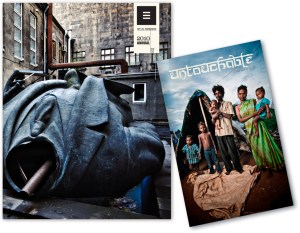
Ready to design on your own? Get inspired by other publishers’ event and sports programs and agendas on MagCloud:


It’s that time of year again…

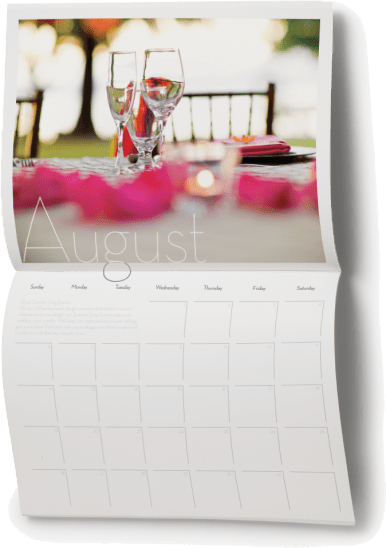
Every year around this time, we see a bevy of calendars popping up on MagCloud. But surprisingly, they are not all what you would think… Sure, there are plenty of family calendars published, undoubtedly intended for distribution to cousins, aunts and grandma, but we think the more interesting use-case are the those being put together by professionals to promote their businesses. And what better way to stay top of mind with your clients, than to be pinned to their wall, where they will see you everyday?

Whether you’re an event planner wanting to showcase your aesthetic, a photographer promoting your work, a non-profit raising awareness or a small business trying to keep your team top of mind with your audience–calendars are a great way to keep your name in front of your client all year long.

Assembling a calendar can be time consuming, so this week we did the heavy lifting for you. Below you will find calendar templates for 3 of the most-frequently used software programs on MagCloud:

Adobe InDesign (CS3 and newer) (zipped version is HERE)

Apple’s iWork Pages

Microsoft Word

You can use these as a starting point for creating your own professional or personal calendar. We won’t spend a ton of time going into the technicalities of how to use these templates because we’ve covered that for Word and Pages last year.

BONUS: if you are using InDesign, there are 3 styles of calendar hidden within the master pages that you can easily apply by changing the master pages for each spread.

Get inspired by some of the great 2011 and 2012 calendars already on MagCloud:


Have you created or found a great calendar on MagCloud? Share the link below in the comments section!

Put MagCloud to Work: Publish a Business Brochure

A wise person once said ‘You never get a second chance to make a first impression’. In fact, it just takes a few seconds or a cursory glance for a person to make a judgment about us. Our subsequent actions, behavior and professionalism may change that perception slightly, but not to a great extent.

So it stands to reason that how you portray your business to prospective clients is almost as important as how you do business.

Whether you are a fashion designer, a multi-media training company, an industry consultant, a yoga studio, or a niche photographer, putting your brand out there in a professional manner is extremely important.

One could argue that a brochure is just as important as your business card. It is an important marketing and sales tool, one in which you can do a little bragging and shamelessly present your business in the most positive light. It is your opportunity to create a lasting impression, so be sure that it is a good one.

Whether you are a company with a staff of 2, 20 or 20,000, MagCloud is a great tool for affordably publishing and distributing your brochures in a professional format. Our full-color, full-bleed print options in both standard and digest trim sizes give you the choice to create a robust brochure of multiple pages, or something simple and portable, like a four-paged digest handout. Digital distribution options also make it easy to share your brochure digitally to a desktop, laptop, the iPad, or other mobile device.

MagCloud’s ship-to-group feature makes it easy to drop-ship seasonal information or annual brochures to your clients around the world. Or, if you are a small business, its on-demand functionality means that you can distribute individual copies as needed to interested clients, allowing you to maintain a professional appearance without exceeding a limited budget.

Once you have these great logistics and beautiful print quality, the only thing holding you back is content, and design. Here are a few tips for gathering the content you should include in your brochures, and how to effectively assemble it into a professional-looking publication.

Getting Started:

Who are you talking to?

The first thing you need to know is what you want your brochure to accomplish. That ties directly into the target audience and what the message of the brochure will be. Identify your target audience and speak directly to them. Never try to address everyone. Once you know who your audience is, it will be easier to target your messaging and articulate that your product or service is a solution to their needs.

What is your message?

Always include a meaningful headline. Your headline should clearly communicate your main point so that even if the reader reads nothing else, they will understand what you are about.

Tell the whole story in your writing. Be concise, but remember to write your body copy in plain English. Don’t use jargon or industry lingo, instead pretend you’re explaining your message to a friend.

It’s helpful to use succinct, pithy copy. Avoid long sentences. Keep your message to the point. Use subheadings liberally, as they break up long copy and help draw a reader through the text. Ideally, a reader should be able to get a good grasp of your message by reading only the headings and subheadings.

Designing Your Brochure: 

When all of your information is gathered and your writing is done, you can finally get down to the business of designing. You’ll want take into account the basic elements of good design – organization, consistent styling, balance, color, and so on.

Lay out your brochure cleanly and professionally. The design should draw the reader in and ease the process of reading. Remember that erring on the simple side will be easier for your consumer than an over-designed, distracting or hard-to-read brochure.

It’s great to use graphics to provide balance with text, but be sure they are relevant to your content. Use graphics that grab your reader’s attention and underline your message. Whether it’s a picture, logo, or stock image, just be sure it relates to your message and brand.

As with any design there are some things you’ll want to avoid. These include:

  • Avoid over-used typefaces, such as Arial and Helvetica. Read more in our recent blog post.
  • For content type, keep the point size under 12.
  • Don’t use more than three type faces in a brochure.
  • Generally don’t use more than one alignment.

If you feel lost…

Starting from scratch on a brochure can be challenging. Some great resources for design inspiration can come from other designs. Try searching the web for brochures in your industry and see how your design stacks up against the competition. You don’t want to copy someone else’s design, but it’s a great way to get inspired.

Also check out the stock templates available within most design and word-processing software. If you aren’t a super-savvy designer using InDesign or Quark, you’ll be amazed what you can do with Apple iWork Pages, Microsoft Word, and Microsoft Publisher. For those who are confident in their skills with the software, but looking to get a more professional look, you can also investigate altering templates from Stocklayouts or Inkd, just be sure you are ready to tweak these designs as they are not all perfectly sized for output through MagCloud.

Have you published your company’s brochure through MagCloud, or found other great resources for inspiration and design? Please share them in the comments below.


Portfolios Made Simpler With Flickr

Have you wanted to create a print portfolio for your photography, artwork or business but don’t have the design skills or the right software to get the job done?
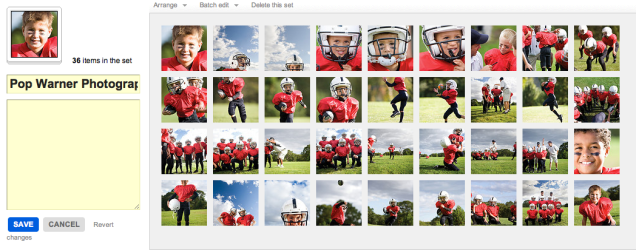

Here at MagCloud we are always looking to make things easier for you, which is why we offer the option to create a print publication using a Flickr photoset. It’s easy to use, and in just a few minutes MagCloud will take a set of your photos on Flickr and lay them out in a simple one-image-per-page template to create a tidy portfolio. What’s great is that it works almost instantly and is very easy to use, so if you need to get a collection off to a potential client immediately, or have procrastinated and need to get something together quick–then this is the tool for you. Follow along with my example below, and give it a try for yourself.

Here’s how it works:

1. Upload your images to Flickr and organize them in a photoset.
Be sure to put the images in the order you wish for them to show in the portfolio. This means your first image will be your cover image, and then the rest will follow. Since each image will be assigned to a page, you will want to have a number that is an increment of 4 (that means 4, 8, 12, 16… etc). My set in this example has 36 images, so it will be 36 pages long.

2. Edit the titles of your photos. (optional)
If you wish to include captions for your photos, such as credit information, location or other details, be sure to edit the titles of your photoset while in Flickr. You’ll have the option to include these titles at the bottom of each page of your final printed portfolio, so you could also use this space to include your contact information or copyright details.

3. Start the creation process at MagCloud.com/publish.
Once you are ready to publish, select the import from Flickr option on the Create Publication page. This will launch the importer, where you can select a photoset from your Flickr account.

4. Select your options and create your file.
The Title and Subtitle you enter here will appear on the cover of your publication. This is also where you can select whether you want to include photo titles and page numbers.

5. Preview your file and set binding options.
Take a quick look at your publication to confirm your settings. You can scroll through every page to see how your portfolio will look. Happy with it? Then select your binding options and publish!

6. You’re done!
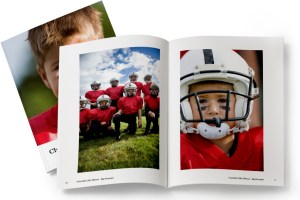
See, now wasn’t that easy? Though this example is that of a children’s sports photographer, the Flickr Import could be used to make portfolios for your jewelry design business, fine art, architecture, decorating, crafts, or graphic design work. How you use it, is up to you.

A few tips and things to consider BEFORE you start your import:

What Image will be on my cover?
For simplicity, this should be the first image in your photoset.

What order do I want my images in?
The order that your images are in within your photoset, is the order they will appear in your MagCloud portfolio.

Which images will be facing on spreads?
If the first image in your set is the cover, then images 2 and 3 will be facing pages. It’s a good idea to go through your set to be sure that you like the arrangement of these photos (are people facing off the pages, or leaning against the outside edge of a page?) if so, you may want to swap around the order of your image.

Do I want to include captions or credits?
Because the title appears at the bottom of the page using this Flickr feature, you can also use this space for copyright information, or to include your contact information. In the examples below you can see how we accomplished this. To be sure every other page has the right information, just be sure to alternate the information in the titles of your images.

Is there any non-photographic content that I want to include like my contact information/ company logo?
To do this you have to get a bit tricky and create an image of the content and save it to flickr. You can use this trick to load verbiage into alternating pages, or if you want to include your company logo and contact information and logo on the back cover, this is a great work-around to do that. Simply create the image in any application that allows you to save an image (Flickr will let you upload JPEGs, non-animated GIFs, PNGs or TIFFs) and add it to your set.

What’s the maximum image size printed with the Flickr upload?
If you want to make sure your photo takes up as much of the page as possible, size it at 1875 by 2625 pixels at a minimum of 300 dots per inch resolution.

Are my images high enough resolution for printing?
The largest image size using the flickr uploader is 2475 by 2475 pixels on the covers and 1875 by 2625 pixels for interior images. For more information about photo quality and printing check out our blog post about getting the most out of your photos.

Can I have more than one photo on a page using the “Upload from Flickr” feature?
The “Upload from Flickr” feature currently only uses one photo per page. If you are adventurous, one way around this is to create a single image file (jpg, gif, png or tiff) that contains multiple photos and upload it as part of your Flickr set. Make sure the single image file is 1875 by 2625 pixels at a minimum of 300 dots per inch resolution. When your MagCloud publication is created, this file will be placed on a single page just like your other photos, creating the impression of multiple images on a single page like this example.

A Few Inspirations For Your Portfolio

As mentioned in our blog series, MagCloud is here to help publish your portfolio and provide options to create a big impression with a small format. So what’s the next step? We thought we’d offer a few examples to inspire you to start or update your existing portfolio. Portfolios are critical for designers, photographers and other small business owners who want to get exposure for their work and land new clients.

Whether you’re a musician, watercolor painter or even a blacksmith, you can capture a moment of creativity by browsing through more than 300 portfolios already on MagCloud. Draw additional inspiration from portfolios of other notable interior designers, graphic designers, and architects. Below are a few more examples of what your fellow publishers have been working on.

This collection of artist’s portfolios is a great example of using our digest format. For those conscious about budgets and the size of your portfolio, digest size provide an efficient way to share your best work in both print and digital formats.

As a small business, Sweet Pea Floral Creations showcases some of their favorite floral arrangements and highlights from client events and weddings.

Just graduated? Compile your best work for a great supplement to your resume, just like this advertising creative portfolio that Lauren Richer created.

Interior and architectural photographer David Duncan Livingston created various portfolios of his clean, welcoming photographs of homes, hospitality and products.

Below is a run-down of additional photography print portfolios that have caught our eyes.

  • The Art of Enzo Mondejar features an avant-garde take on portraiture by the gifted photographer, Enzo Mondejar. The images are creatively captivating and we hope they offer some inspiration for your print portfolio.
  • Nevertheless is the creative output of Peter Olschinsky, Verena Weiss and Gerhard Weib. This gorgeous layout design can teach us all more about how to present our images in the best light and perspective.
  • Finally, the Lolli POP Project is the work of photographer Massimo Gammacurta and is a great example of letting color explode onto a printed page and take off. Featured in Wired Magazine in December 2010, this project is both eye-catching and salivating.

What other portfolios have you seen that help inspire you to create your own? Share them with us in the comments below.

Ship As Much As You Want, Wherever You Want

Starting today, we are removing the 300-page restriction on MagCloud shipments outside the United States, United Kingdom and Canada. Now, you can ship publications of any size, in any quantity, to any country! Not only that, but we’ve expanded the shipping options available for worldwide destinations, adding faster and more reliable service through FedEx.

You can opt for FedEx International Priority service and have your order in 5 business days from the date of purchase. If you can wait a little longer, you could save some money with FedEx International Economy service and have your order in hand in 7 business days. With both of these FedEx options, we’ll send you a tracking number as soon as the order ships so you can keep an eye on it as it travels from our print facilities to your doorstep, no matter where that is in the world.

One thing to keep in mind with these new larger FedEx shipments is that they may be subject to import taxes, customs duties, and fees imposed by the destination country, which may cause delays beyond our original delivery estimates. Since customs policies vary widely from country to country, we have no control over these charges nor can we predict what they may be, so it will be the responsibility of the recipient to cover any additional charges that may come up. For information on potential taxes and fees specific to your country, we suggest contacting your local customs office, or viewing the applicable FedEx country profile.

If you are willing to wait for your shipment, for orders weighing less than a pound we also have a cheaper shipping option through USPS International First Class Mail. See the table below for a comparison of turnaround times and tracking availability for these new shipping methods.

Costs vary by country and order size. To see the new shipping options available for your country, and what they cost, check out our Price Calculator.

We’re Giving Back Even More of the Back Page

Last month, we announced that we were shrinking the label on the back cover to only 1.4” wide, and today we are excited to share that we have taken it a step further. Starting today, all MagCloud print publications will include only a small 6 mm square 2D barcode in the lower righthand corner of the back cover. This barcode allows us to process your order through our printing, binding, and shipping processes as efficiently as possible, while minimizing the impact on your back cover real estate.

For those of you who have been publishing with MagCloud for a while, take a walk down memory lane with this timeline of our ever-shrinking back page label. And as always, let us know what you think!

A Helping Hand

Need help creating or marketing your next publication?

Our Help section now includes a directory of templates, photography, design, advertising resources and more.  You can also find the the most popular design tips from our blog and latest How to Guides.

Still can’t find what you are looking for then visit the Ask MagCloud section to browse frequently asked questions about publishing, printing and shipping with MagCloud.

Our support team is also happy to answer any questions you can’t find answers for on our website.  Simply contact us so we can help you get the information you are looking for.

Know of a great resource that would help the MagCloud community?  Please drop us a line, we would love to hear about them.

Use MagCloud To Publish Your Portfolio

Today we begin a new blog series highlighting some of the great use cases we’ve seen people publish on MagCloud, along with design tips and inspiration to help you create your own publications. First up: portfolios.

On MagCloud we’ve seen portfolios that run the gamut from photography to fashion, architecture to interior design, music to floral arranging. With both print and digital options, uploading your portfolio to MagCloud is an easy way to spread the word about your work across a variety of mediums. With one PDF upload, you can have professionally printed books that you can send ahead or leave behind, as well as downloadable PDFs that can be displayed on any mobile device or computer.

When designing your portfolio PDF for MagCloud, a good starting point are the downloadable instruction packets on our Getting Started page for your software of choice. These step-by-step instructions will help you take your file from document setup to PDF export, and help ensure that your final publication matches MagCloud’s print specifications.

Once your file is set up, the next step is selecting your content. Since the goal of any portfolio is to highlight your work, for many industries, images will be the focal point of your content. When selecting your images, it’s important to remember to choose photos that are high enough resolution for printing, and ensure that your color profiles are embedded in your final PDF. Doing so will ensure the highest quality output of your images in print, setting a good foundation for the rest of your layout.

Which brings us to our next step, placing content in your document. When designing your portfolio layout, it’s good to determine what samples of your work you want to feature and then make that the focal point of each two-page spread. This will ensure that your work stays in the spotlight throughout the publication. If you will be using our perfect bound option, which provides a more professional look and feel with a square binding and thicker cover, don’t forget to check out our design tips for perfect binding when designing your layout to make sure you don’t lose any content into the spine.

We will be providing sources of inspiration throughout the series, but to encourage you to get something in hand to inspire your portfolio design sooner rather than later, we are lowering the production cost on print orders of the following well-designed MagCloud portfolios until the end of October:

Trey Hill Photography Annual: Issue 1: 2010” by Trey Hill
California Kitchens Now” by David Duncan Livingston
James Worrell Photographs: Make Up” by James Worrell

Have you published a portfolio showcasing your work on MagCloud? Share it in the comments below, and let us know what was most important to you when designing the publication. Then, stay tuned to the MagCloud blog as we continue this new series in the coming weeks with more design tips, sources of inspiration, and a few surprises.

To Serif or Sans Serif? Typefaces Make A Difference

Typography is the cornerstone of graphic design. It’s what brings character to your magazine, catalog, brochure or newsletter. It should never be overlooked or left to the end of your project. Typography should be considered during initial design phases and should be allowed to impact your layout and image choices. Why is it so important? Because the typography you choose sets the tone for your readers. It helps you tell your story in a way that an image (or even your copy) can’t.

Being fans of infographics, we came across this little gem recently which has generated quite a bit of conversation in the office. It’s sort of an ABC guide to typography which has also sparked interest on our Facebook and Twitter channels. The MagCloud community is clamoring for typography tips so we thought we reiterate these 4 professional tips from the Noodlor infographic:

1. Limit yourself to a maximum of 3 well contrasting typefaces.

2. 95% of graphic design is typography. Treat it well!

3. First, start off on paper, then move on to your computer!

4. When you’re stuck…discard old ideas and start fresh!

Still need convincing? Check out this video from typographer and graphic designer Erik Spiekermann. He breaks down the elements of typography and explains what makes it such a key part of any design.

Erik Spiekermann – Putting Back the Face into Typeface from Gestalten on Vimeo.

Also check out our recent blog post on Typeface Do’s and Don’ts for additional insight in how best to use typefaces in your next portfolio, magazine, brochure or other print project.

Share your thoughts on the art of typography as a comment below. Is it something you spend a lot of time on when designing your MagCloud publication?